
Table of Contents
 charlie
8 months ago
Design Research Methodology: A Complete Guide for Students and Professionals
Design research methodology is the backbone of thoughtful, user-centered design.. A properly designed methodology will guide designers through assumptions to evidence and thoughts to action. This extensive research approach guide presents the dynamics of design research, the rationale behind it, and the application of research in the various industries.
The current competitive environment makes it dangerous to design without research. When design is made with the inclusion of research, it becomes strategy, clarity and confidence.
Why Design Research Matters
Design research provides patterns to creativity and provides way of clarity in decision-making. In high-speed markets, it is blindfolded research, like driving, and then possible but dangerous. It makes sure that all design decisions are grounded on actual user knowledge and not baseless predictions and passing trends.
Helps Understand User Needs and Behaviors
Design research will allow the teams to view users in their real light, rather than an idealized version. Researchers discover both practical needs and emotional needs through studying real-life interactions, which determine the behavior.
-
Identify explicit needs that users can clearly articulate
-
Reveal hidden frustrations and unmet expectations that often go unnoticed
-
Explore emotional, cultural, and contextual factors influencing behavior
-
Map complete user journeys to understand actions, decisions, and pain points
Such a level of insight enables the designers to come up with solutions that are natural and user-friendly, as well as useful.
Reduces Risk of Failed Product Launches
The most widespread reason behind failure is manifested by launching without research. Design research eliminates the risk of uncertainty since it tests concepts prior to them becoming expensive investments.
-
Validates problem–solution fit at early stages
-
Identifies potential usability and adoption issues
-
Reduces costly rework after launch
-
Improves confidence in go-to-market decisions
Early identification of the issues makes resources available and helps to safeguard the brand image.
Supports Data-Driven Decision-Making
Design research makes the subjective opinions evidence. The ones supported by data are more transparent and arguable.
-
Travel with qualitative understanding and quantitative validation.
-
Present tangible support of strategic decisions.
-
Concur around cross-functional teams on common discoveries.
-
lessen intra-organizational competition based on personal prejudice.
The data-driven design establishes consistency and responsibility in projects.
Drives Innovation and Creativity
Creativity is not aspired by research; it is at its best refined. The design research unveils the prospects that lead to significant innovation.
-
Identifies gaps in existing products and services
-
Surfaces emerging behaviors and unmet user needs
-
Inspires new concepts grounded in reality
-
Encourages experimentation within informed constraints
The innovating becomes meaningful, and it addresses real issues rather than novelty.
Enhances Brand Value and User Satisfaction
When the users feel that they are heard, they give trust and loyalty. Design research produces experiences that are amazing and surpass the expectations every time.
-
Enhance usability and quality of the experience.
-
Nurture emotional attachment, use intelligent design.
-
Increase customer satisfaction and retention.
-
Build brand credibility and positioning.
In the long term, experience results in the brand becoming a reliable and referable experience to users based on the research-driven design.
Design Research vs Other Research Types
Understanding the difference between research method and methodology is essential when choosing the right research approach. Methods are the specific tools you use like interviews, surveys, or observations while methodology is the overall strategy that guides why, how, and when these methods are applied.This distinction, explained in this Comprehensive research methodology guide, ensures research is effective, actionable, and aligned with project goals.
Correspondence with Market Research.
-
Target Markets, Trends, Target Gap and Business Prospects.
-
Decides the desired demand, adoption attractiveness and market practicality.
-
While market research focuses on commercial metrics, design research prioritizes understanding user needs, behaviors, and experiences. It digs into why users act a certain way rather than only if they will buy.
Comparison with Academic Research
-
Academic research emphasizes theory building, knowledge contribution, and long-term study.
-
Advances scholarly understanding and validates hypotheses through rigorous investigation.
-
Design research is applied and practical. It focuses on solving real-world design problems and generating insights that can be directly used to improve products and services, rather than purely theoretical knowledge.
Comparison with User Experience (UX) Research
-
UX research focuses on interaction of usability, interface, product interaction.
-
It enhances digital or physical experiences to make them more efficient and clear/easy to use.
-
Design research has a broader scope. It considers emotional and cultural factors and factors and usability. Whereas UX research inquires about the usability of a system, design research inquires about the adequacy of a solution in addressing the needs of users and how well the solution fits.
When to Use Each Research Approach
-
Ideal for concept development, exploring complex user problems, and identifying unmet needs. It provides insights that guide strategy and innovation.
-
Best for usability testing, workflow improvements, and interface optimization. It ensures products are intuitive and easy to use.
-
Useful for validating demand, understanding competition, and shaping commercial strategy. It ensures that products are viable and aligned with market realities.
Design Research Process / Methodology
To truly learn about research methodology, it’s essential to follow a structured, stepwise approach. A clear process guarantees insights/data to be credible, practical and linked to the design objectives. Research may be disjointed, skewed or lack what is required by the users without a systematic methodology.
Stepwise Research Process:
Discover - This stage involves mapping the problem space. Stakeholders in the spot market, predetermined goals, and analyze the surrounding environment. Early discovery makes research purpose and goal.
Explore- Spend time with users in natural environments, interview, and collect qualitative data. Research behaviors, determining motivation, difficulties, and environmental forces that direct the experience.
Test- Validate concepts, assumptions or prototypes. Find out whether your solutions are a response to the actual user requirements by using usability testing, surveys, and experiments.
Listen – Gather continuous feedback from users and stakeholders. Analyze results, iterate designs, and refine solutions. Listening ensures designs evolve based on actual user behavior rather than guesswork.
Importance of Systematic Research for Reliability
-
Ensures findings are consistent, credible, and actionable
-
Reduces researcher bias and misinterpretation
-
Provides a replicable framework for future projects
-
Strengthens decision-making with evidence-backed insights
Combining Qualitative and Quantitative Approaches
-
Qualitative Research reveals why users act in a particular manner by conducting interviews, observations, and contextual inquiries.
-
Quantitative Research determines how frequently users act in a particular way by conducting surveys, analysis, or statistical software.
By combining these methods, a complete understanding of user needs is achieved, offering a balance of in-depth information and data-driven trends for more informed design choices.
Documentation for Analysis and Insights
-
Records raw data, information, and observations in an organized manner
-
Aids in the identification of trends and patterns
-
Facilitates the communication of insights across teams
-
Builds a knowledge base for continuous improvement and future projects
Tools and Techniques for Design Research
A strong design research methodology depends on the right tools to collect, analyze, and interpret data efficiently. The choice of the right tools will mean that accuracy, depth and actionable results will be achieved.
Quantitative Research Tools.
-
SPSS -High level statistics, hypothesis test, and modeling.
-
Excel -Arrange, tabulate and manipulate numbers.
-
Python - sensible sorting of tasks, data, and other intricate analytics.
Qualitative Research Tools
-
Interviews - Learn so much about user motivations, frustrations and wishes.
-
Observations- Capture the behavior of users in real life scenarios.
-
Field Studies and Diary Methods: major patterns of long-term behavior, long-term usage patterns.
Hybrid and Advanced Approaches
-
Mixed-Method Research - integrates qualitative insights and quantitative validation in order to gain a holistic idea.
-
AI-Empowered Research Tools - Data collection, pattern recognition, and sentiment analysis should be automated to make it more productive.
-
Techniques of Data Visualization - Intake the complicated sets of data and convert them into distinct visual narratives to make informed design choices.
By integrating the right tools within a structured design research methodology, teams can extract meaningful insights that directly inform design strategy, reduce risk, and create products that truly meet user needs.
Benefits of Design Research
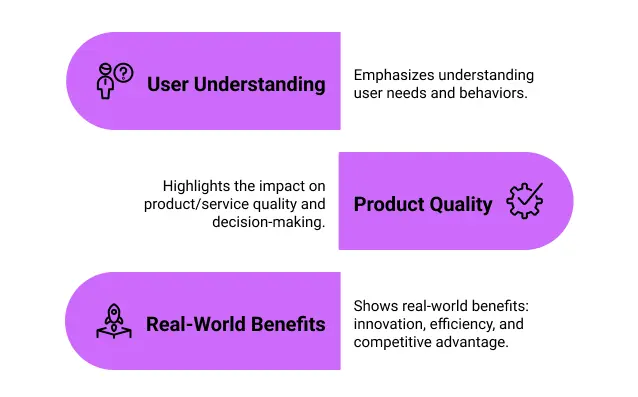
Successful projects allow design research. It is not only useful; it facilitates education, training students and professionals to make decisions based not on guesses but on evidence, providing Academic help and solutions.
The main benefits are:
Informed, evidence-based decision-making: All decisions are supported with factual data and information of actual users of the product and this minimizes guess work and increases precision.
Cost and time efficiency: Early idea validation enables teams to make fewer and costly errors and redesign less.
Deep understanding of user preferences: Needs, behaviors, and motivations are known through research and solutions are within the expectation of the real expectations.
Discovery of new opportunities or gaps: It reveals unsatisfied needs, points of pain and innovation opportunities that could otherwise be overlooked.
Stronger product-market fit and competitive edge: Research-based products have higher chances of succeeding, being relevant to the users, and becoming superior to rival products.
Incorporation of design research into strategy and development produces usable not meaningless and ready to market products.
Common Mistakes in Design Research
Even experienced teams can falter if they misunderstand the difference between research method and methodology. Many common mistakes undermine research quality and its impact on design decisions:
-
Ignoring user feedback: Overlooking or discounting user input leads to solutions that don’t address real problems.
-
Relying on assumptions instead of data: Designing based on intuition or internal opinions introduces bias and increases failure risk.
-
Poor documentation and reporting: Without clear records, insights are lost, making it difficult to analyze, share, or act on findings.
-
Misapplication of research methods: Using the wrong tool for the research goal can yield irrelevant or misleading results.
-
Ignoring cultural and regional contexts: Overlooking environmental, social, or cultural factors can result in solutions that don’t resonate with users globally.
Avoiding these mistakes requires understanding methodology as a strategic framework, not just a collection of tools.
Conclusion
Mastering a robust design research methodology is essential for modern design projects. A strong methodology ensures that research is systematic, repeatable, and produces insights that can guide decision-making effectively.
Understanding the difference between research method and methodology is crucial. Methods are the approaches that are taken in gathering data whereas methodology gives the justification and pattern of how methods are to be utilized in order to solve a problem.
Key takeaways for mastering design research:
-
Understand the use of research to develop user-oriented, market solutions.
-
Strengthen systemic approach in order to ascertain that insights are accurate, trustworthy, and beneficial.
-
Use quantitative and qualitative techniques together to create a one-stop solution to the needs and behavior of users.
-
Continuous improvement and constantly learning should be practiced to update the understanding with time with the changing user situation.
By following these principles, teams can design with confidence, reduce risk, and create products and services that truly resonate with users while maintaining a competitive advantage.