
Table of Contents
 George
8 months ago
How to Write an Abstract of a Research Paper: Step-by-Step Academic Guide
An abstract of research paper is the most powerful summary in academic writing. The editors, reviewers, and even the researchers who read the paper normally stick to it by reading the first part, and depending on it, they either read the entire paper or scrap it.
Within the restricted number of words, the abstract will briefly give an overview of the entire research, including purpose, methods, results, and significance. Because this section directly influences acceptance, indexing, and visibility, many students seek professional research paper assistance to get it right.
Though of importance, students usually have difficulties with:
-
Summarizing complicated studies within few words.
-
Being transparent and organized.
-
Adherence to rigorous academic regulations.
What Is an Abstract of a Research Paper?
An abstract of research paper is a concise and self-contained summary that represents the entire research study. It allows readers to quickly understand what the study is about without reading the full document.
A well-written abstract has the following defining characteristics:
-
It can be read independently from the main paper
-
It accurately reflects the full scope of the research
-
It avoids unnecessary background or literature review
-
It presents completed work, not proposed research
Importantly, an abstract does not focus only on the introduction or problem statement. Instead, it mirrors the entire research lifecycle from motivation to methodology to outcomes ensuring readers understand exactly what was done and why it matters.
Purpose of an Abstract in Academic Writing
The abstract has several fundamental academic, appraisal as well as practical functions. Its purpose goes way beyond summarization.
Key purposes include:
-
Helping readers quickly assess relevance:
The abstracts are used by researchers to investigate whether a paper is relevant in the field of study.
-
Assisting examiners and reviewers:
Abstracts will enable the evaluators to assess originality, conciseness and contribution.
-
Acting as a gateway to the full paper:
The abstract must be of a compelling nature to encourage the readers to study the entire research.
- Supporting discoverability and indexing:
Abstract submission introduces the terms and themes to the academic databases and search engines.
In most instances, the abstract is the only thing that is read; hence, it makes it the sole most noticeable aspect of the research.
Importance of an Abstract of Research Paper for Indexing & Visibility
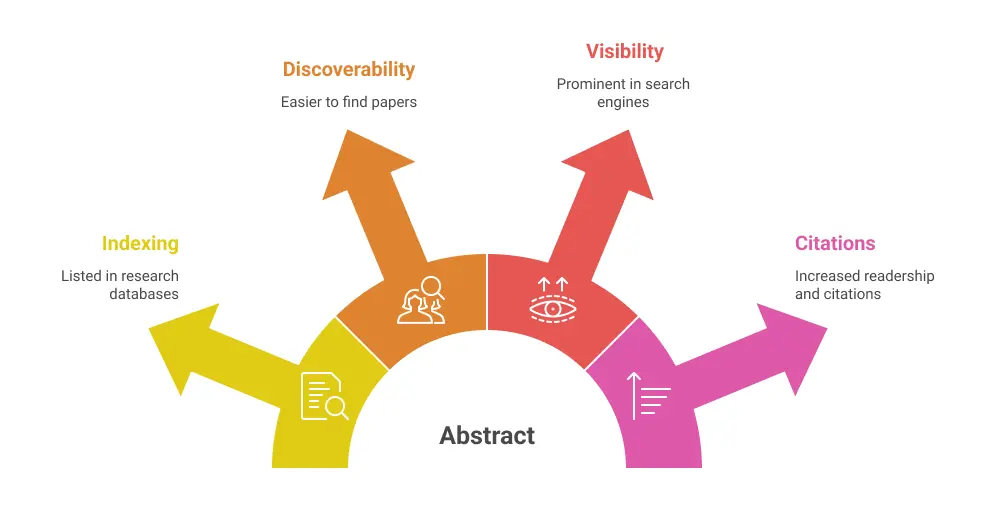
The abstract of research paper plays a vital role in how research is discovered and accessed online. According to official research paper explanation guidelines, abstracts are heavily used by academic databases for indexing and classification.
The advantages of visibility are:
-
Helps in the classification of subjects in the databases.
-
Enables scholars to find suitable studies in a short period of time.
-
Relates work to the right audience.
-
Increases the possibility of references and a broader audience.
An abstract that has been written well, and that is keyword optimised, stands a high chance of being cited and referred to within the global context.
Standard Length and Formatting Rules for Abstracts
Abstracts will also be restricted to the rules of length and formatting depending on the discipline and journal used.
Common rules include:
Word limits across disciplines
Limitations in words are dependent on field and place of publication.
-
Humanities and Social Sciences: 150- 200 words, sufficient to provide a context and the purposes of study and its importance.
-
Sciences and engineering: 200-250 words, in which you can briefly describe methods, findings, and conclusions.
-
Medical and Clinical Research: 300 words or less, the writing is usually organized so as to encompass in-depth procedures and results.
-
Never exceed the maximum word count specified by the target journal, conference, or institution to avoid rejection or the need for revisions.
Format style
-
Single-Paragraph Abstracts:
These abstracts are popular in most fields. The background, objectives, methods, results, and conclusions are woven to become one continuous flow.
-
Structured Abstracts:
Frequently required in medical, clinical, and scientific research, divided into labeled sections such as Background, Objectives, Methods, Results, and Conclusions.
Core Components of an Abstract of Research Paper
A properly prepared abstract integrates a combination of various critical aspects in a rational, logical flow. The roles of each part are different, and they contribute to the presentation of the research in a limited number of words. When properly integrated, these things will make sure that the abstract is a precise representation of the entire study and meets the requirements of the academic paper.
Research Background
The literature review then provides a brief context of the study. It provides an introduction of the larger problem area or gap in research that is being tackled in the study, without explaining the literature review in detail or history per se.
The main points in the background of the research are:
-
Determining the broad subject/ area of study.
-
Identification of the problem, issue or gap of the current research.
-
Adequate context must also be provided to explain the reason why the study was done.
This part assists the reader in knowing the relevance of the research at the first stage itself.
Research Objective
The research objective clearly states what the study aims to achieve. It defines the purpose of the research in a direct and focused manner.
An effective research objective should:
-
Clearly state the main aim or research question
-
Avoid vague or overly broad statements
-
Align directly with the methods and results discussed later
This component ensures that readers know exactly what the researcher intended to investigate or accomplish.
Methodology Overview
The overview of the methodology provides a summary of the way the research was carried out. It provides the readers with the wisdom concerning the research method without plunging them into technicalities.
In this section, it normally consists of:
-
Research design (qualitative, quantitative or mixed-methods)
-
Sample characteristics or sources of data.
-
The tools, techniques/methods of analysis that were important.
The aim is to give sufficient methodological data to bring out credibility and clarity.
Key Findings or Results
The most important findings or the results are indicated in the key findings section. It is the most important section of the abstract often because it discloses what has actually been found within the research.
Good presentation of findings entails:
-
Summarizing major findings clearly and objectively
-
Focusing on outcomes that directly address the research objective
-
Avoiding raw data, tables, or statistical detail
Readers rely on this section to judge the value and contribution of the research.
Significance and Implications
Section on significance and implications elaborates the meaning of the importance of the research. It relates the findings to the larger academic, practical or societal contexts.
It may highlight:
-
Theoretical input into the field.
-
Policy applicability or application.
-
The way the findings can inform future research.
This part assists in placing the research into the context of the greater academic environment and illustrates its influence.
Types of Abstracts Used in Research Papers
Various research areas as well as journals, demand the use of different kinds of abstracts. All types are different in nature and fulfill particular functions and differ in structure, depth and content. To determine the type of abstract to be used, it is necessary to consider the journal requirements and the ease with which the research will be written.The most commonly used types of abstracts in research papers are explained below:
Descriptive Abstract
A descriptive abstract gives general information about the study without showing the results and conclusions in detail. It is more concerned with the description of the topic, the scope, and the objective of the research instead of presenting the results.
The main characteristics of descriptive abstract are:
-
Provides a description of the topic and the study object.
-
Outlines the paper scope and paper structure.
-
It does not have results, data, or conclusions.
-
Can be frequently found in the domain of the humanities and theoretical research.
Such an abstract aids the readers to know what the paper discusses but he or she has to read it to get the results.
Informative Abstract
A descriptive abstract is the most commonly used type of academic research. It is a definitive overview of the research and some of the major findings and conclusions.
The features of an informative abstract are:
-
Expresses the purpose of the research in a straightforward manner.
-
Overviews methodology and approach.
-
List significant findings/results.
-
Formats major conclusions or implications.
Informative abstracts also enable the reader to be able to emerge into the picture of the research value without necessarily going through the complete paper.
Structured Abstract
Formatted abstract is systematic on a heading based format. All of the parts of the abstract are well-marked to enhance readability and understanding.
A normal structured abstract will consist of such headings as:
-
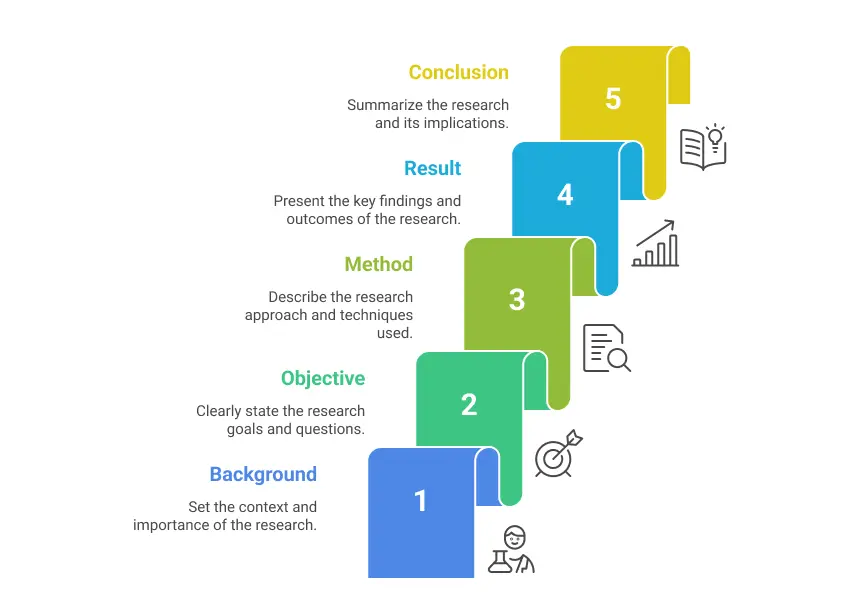
Background
Briefly introduces the research context, highlights the problem or gap being addressed, and explains why the study is necessary. -
Objectives
Clearly states the aim of the study or the specific research questions being investigated. -
Methods
Summarizes the research design, data collection process, sample size, tools, and analytical techniques used in the study. -
Results
Presents the most important findings or outcomes of the research, focusing on key trends or significant results. - Conclusions
Interprets the findings, highlights their significance, and explains their academic or practical implications.
In medical, clinical, and scientific studies, structured abstracts are a typical practice because they allow researchers to easily compare and estimate different studies.
Graphical Abstract
The graphical abstract displays the main findings of the research in a research in graphical format. It will summarize the significant message of the study with the help of images, diagrams, or flowcharts.
The important details found in any graphical abstract:
-
Graphical display of the research findings.
-
Makes things complicated simple.
-
Increases activity and better understanding.
-
Typical of high-impact scientific journals.
Graphical abstracts are used to enhance the presence and involvement of readers as they tend to display graphical abstracts in conjunction with text abstracts.
When Should You Write the Abstract?
The abstract should always be written after completing the full paper. Summarizing it before the research is completed usually results in incomplete, inaccurate or misleading summaries.
The most appropriate time to write the abstract is:
-
After finalizing results and conclusions
This will make sure that all major findings, interpretations and results are properly translated in the abstract.
-
After completing the discussion section
Thus the implications and significance of the research is very clear.
-
Before final editing and submission
In order to have uniformity between the abstract and the main paper.
Composing the abstract here will ensure its accuracy, consistency and compatibility with the wholeness of the research paper thus strictly speaking, the abstract can present the integrity of the research paper.
Common Mistakes Students Make in Abstract Writing
Students often reduce the effectiveness of an abstract of research paper by making avoidable mistakes that affect clarity and credibility.
Common mistakes include:
-
Ignoring prescribed limits can lead to rejection by journals or institutions
-
Abstracts should be self-contained and not include external sources
-
All points mentioned in the abstract must be discussed in the main paper
-
Fails to highlight the study’s originality and contribution
Step-by-Step Approach to Writing an Effective Abstract
A structured approach simplifies the abstract-writing process and improves quality.
Follow these steps:
-
Identify the core research objective clearly
-
Extract only the most important results
-
Condense the methodology into one precise sentence
-
Highlight the academic or practical significance
-
Edit rigorously for clarity, flow, and word count
Using an academic support platform can help students refine structure, improve language accuracy, and ensure compliance with academic standards.
Discipline-Specific Abstract Expectations
Abstract requirements vary across academic disciplines, and understanding these differences is essential for successful submission and publication.
Typical discipline-related expectations are:
-
Social sciences – offer a balanced approach to the explanation of theory, methods and findings.
-
Humanities - compose a summary that is argumentative and puts more of an emphasis on interpretation and critical thought.
-
Sciences - result-oriented abstracts highlighting empirical outcomes
-
Medical research – Structured abstracts with standardized headings
Between the disciplinary conventions and the abstract one should align to enhance the degree of clarity, relevance and acceptance.
Conclusion
An abstract of a research paper is a very important section of academic writing. It presents the study to readers in a very brief format, stating the purpose, methods, results and importance.
An abstract should be well-written, correct and scholarly. Being a researcher or a student, a clearly formulated abstract enhances visibility, credibility and scholarship.
Learning how to write abstractly will make scholars sure that they can outline their work and be clear and authoritative enough to get to the right academic audience.