
Table of Contents

 Heilin Mathew
7 months ago
Web of Science Search – Accurate Journal, Author & Impact Factor Insights for Researchers
When we refer to producing credible research, one source we always ensure to rely on is the search of journals from the Web of Science. This is because academics like us always want to know credible sources, monitor citations, evaluate the standard of our research, and avoid predatory journals that may compromise our work.
We’ve all faced the confusion navigating indexing rules, interpreting impact factors, and assessing journal credibility can feel overwhelming. That’s exactly why expert guidance for Web of Science journals is so valuable. With the right support, we can simplify the process, focus on selecting the best journals, and make data-driven decisions without getting lost in theory or metrics.
By using Web of Science strategically, we don’t merely locate journals; we determine where our work could have the greatest influence, measure our influence, and make informed decisions to further our learning journey.
Why Web of Science Search Is Critical for Academic Research
When we start publishing, one of the first things we do is a Web of Science search. It helps us make sure our research is credible, trackable, and visible. Without it, we risk submitting to journals that won’t give our work the recognition it deserves. We’ve all seen colleagues struggle with confusing impact factors, indexing issues, and journal credibility concerns. This is exactly why using the platform strategically matters.
Ensuring Research Credibility and Indexing Accuracy
We make use of the Web of Science in selecting appropriately indexed journals to ensure that we are recognized, credible, and easily discoverable.
Supporting High-Impact and Citation-Driven Research
We identify the strategic publications that maximize the outreach and prominence of our research by examining trends in citations and journal performance data.
Role in Institutional and Funding Evaluations
Since funding bodies and institutions value the impact factor rating of the Web of Science, we select journals to enhance our chances of successful grants, promotions, and career progressions.
Difference Between Indexed and Non-Indexed Sources
We only select indexed journals that have been peer-reviewed. Non-indexed journals may lower the credibility and visibility of our research.
Understanding Web of Science Web of Knowledge Platform
We often think of Web of Science Web of Knowledge as just a database, but it’s a complete research ecosystem. It integrates journals, citations, author profiles, and analytics seamlessly.
Even experienced researchers can struggle with its advanced features. That’s why we often rely on trusted academic publication experts to navigate searches, analyze data, and maximize the platform’s potential efficiently.
Core Collection and Its Research Value
We often start our search with the Core Collection, as it houses the most reputable journals. Using it assures us that our references are credible and that our research will gain proper visibility.
Citation Indexes and Analytics Tools
We use citation indexes and analytics to track how our work and others’ is cited. It serves to inform us about the size of the impact, what the key trends are, and therefore helps us in planning judiciously.
How Web of Knowledge Supports Literature Mapping
It helps us, through mapping literature, to visualize the relationship that exists between studies, identify gaps, and place our research. It is an effective means for us to understand the big picture of academia.
Common Issues Faced by Users While Using the Site
Even seasoned researchers can feel overwhelmed at times. Filters, metrics, and author profiles are complicating factors, where even the slightest missteps can stand in the way of progress. That's why, to us, expert guidance makes all the difference.
Web of Science Author Search for Research Visibility and Evaluation
When we want to measure our real academic impact, we go to the Web of Science author search. It helps us to trace the number of publications, citation history, h-index calculation, and how our work is connected in global research networks.
But let's be honest, author profiles aren't always clean and simple. Variations in names, duplication of records, and fragmentation of profiles skew our metrics. That is why careful analysis and sometimes expert assistance ensure that accurate author identification and reliable evaluation are undertaken.
Author Publication and Citation Tracking
-
We consolidate all the indexed publications under one verified profile, and thus we can track the growth of citations effectively while measuring productivity trends and long-term consistency in research.
-
By mapping citation patterns, we were able to identify high-performing studies, trace topical influence, and recognize how our research meaningfully contributes within the larger academic landscape.
Managing Name Variations and Author Disambiguation
-
Most of us publish under variant initials, name changes, or multiple affiliations, which usually creates fragmentary or incomplete author profiles in the indexing databases.
-
We consolidate fragmented records through structured author disambiguation so that our citation counts, h-index, and scholarly contributions will be accurately represented and professionally validated.
Evaluating Research Influence Using Author Metrics
-
We rely on h-index, total citations, and collaboration data to monitor tenured research impact. We utilize these sources to measure our academic consistency over the years.
-
These figures, if viewed strategically, can actually reveal how we genuinely contribute to the world of academics by focusing on the content rather than the quantity of publications.
The Importance for Career Advancement and Funding
-
Accurate author metrics have a direct impact on promotions, tenure considerations, competitive grant approvals, and institutional performance evaluations within increasingly challenging academic settings.
-
By ensuring our Web of Science author profile is current, we can increase our professional standing and place ourselves in an advantageous position for advancement in research funding and opportunities.
Web of Science Impact Factor and Journal Impact Evaluation
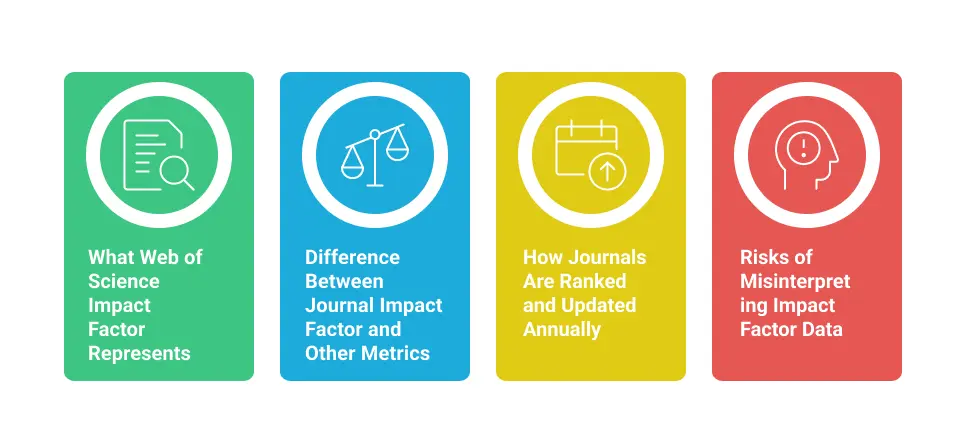
While the WoS impact factor decides the reputation of a journal and manuscript acceptance, and even academic evaluation, its calculation is misunderstood by many researchers. We need to interpret it in a responsible way, rather than blindly chasing rankings.
What Web of Science Impact Factor Represents
If we consider the impact factor of Web of Science, we find the average number of citations that articles receive over two years, information that is related to the performance of the journals themselves, rather than our individual performance.
Difference Between Journal Impact Factor and Other Metrics
Even though the Journal Impact Factor is more emphasized, CiteScore, SNIP, and h-index should be taken into account due to their ability to evaluate scholarly influence differently from each other.
How Journals Are Ranked and Updated Annually
Each year, journals are re-ranked within subject categories based on the most current citation data; consequently, the journals we target may move quartiles.
Risks of Misinterpreting Impact Factor Data
Misunderstanding what our impact factor data tells us can cause us to focus on prestige instead of purpose and diminish the value of important contributions to knowledge, no matter how poorly they might be cited in the near future.
Using Web of Science Search for Journal Selection and Validation
By using Web of Science search strategically, we can pinpoint journals that truly match our research scope, indexing status, and impact metrics. Relying on expert validation helps us avoid submitting to journals that don’t fit or have low visibility, saving time and increasing our chances of acceptance.
Matching Research Scope with Journal Aims
When we make sure our work aligns with a journal’s objectives, it boosts the likelihood of acceptance and ensures that our research reaches the right audience. This alignment helps our work get noticed and cited by peers who matter most.
Verifying Indexing and Citation Performance
We need to confirm that the journals we target are properly indexed and have strong citation records. This verification ensures our research is visible in the academic community and recognised in the right circles.
Matching Research Scope with Journal Aims
Making sure our work aligns with a journal’s focus is key. When we target journals whose objectives match our research, it not only increases our chances of acceptance but also ensures that our work reaches the audience that matters. This kind of alignment helps our research get noticed, read, and cited by the right peers.
Verifying Indexing and Citation Performance
Before submitting, we need to check that the journals we’re considering are properly indexed and have strong citation records. Doing this ensures that our research is visible in the academic community and recognised where it counts. It’s all about making sure our work gets the reach and impact it deserves.
Fast Publishing Web of Science Journals – Opportunities and Risks
When we publish in Web of Science journals, speed is tempting. Understanding the definition of Web of Science helps us choose wisely.
Quality or ethics can be hurt by rushing. Following expert guidance keeps our work credible while still reaching readers quickly and efficiently.
Why Researchers Seek Fast Publishing Journals
We need to be able to publish quickly, sometimes in order to meet deadlines or funding or career goals. Speed is useful, but quality cannot be sacrificed.
Legitimate Fast-Track vs. Risky Publication Claims
Some journals genuinely fast-track peer review. Others exaggerate speed. Expert advice helps us to choose reliable journals and avoid risky ones.
Factors Affecting the Speed of Reviews and Acceptance
Examinations can take a variable time depending on the quality of manuscripts, the availability of reviewers, and the editorial flow. This realises that it helps us to develop a realistic expectation for our submissions.
Common Challenges Researchers Face While Using Web of Science Search
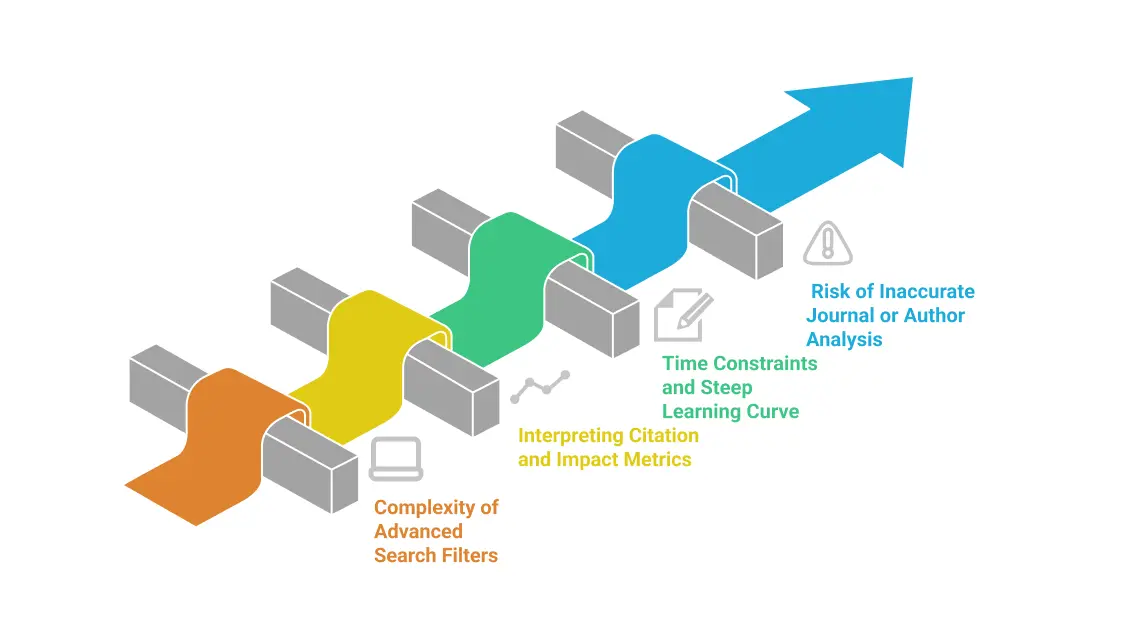
Using Web of Science search can be overwhelming. We often deal with complex filters, too much data, confusing metrics, and tough decisions.
Complexity of Advanced Search Filters
Advanced filters are useful but tricky. We sometimes spend more time figuring out search options than actually focusing on our research.
Interpreting Citation and Impact Metrics
Metrics like citations and impact factors can be confusing. We risk targeting the wrong journals if we misread these numbers.
Time Constraints and Steep Learning Curve
Learning the platform properly takes time. Balancing research, writing, and navigating Web of Science often feels stressful and exhausting.
Risk of Inaccurate Journal or Author Analysis
Mistakes in journal selection or author tracking can happen easily. We may lose visibility or credibility if our analysis isn’t accurate.
How Expert Support Enhances Web of Science Search Outcomes
Expert support transforms raw Web of Science data into practical insights. We can choose journals, interpret impact factors, and track authors efficiently.
Accurate Journal and Impact Factor Evaluation
Experts instruct us to be cautious with the choice of journals and their impact factors so that our submissions aim correctly at real journals and allow the maximum visibility of the research in question.
Author Profile and Citation Analysis Support
Guidance helps us to consolidate author profiles and track citations more accurately, giving a comprehensive picture of our research impact and influence.
Strategic Guidance on How to Publish Faster and Safer
Expert advice ensures faster, ethical publication. We balance speed with quality, improving submission strategies, maintaining the integrity of research and credibility.
Reduction of Rejection and Revision Cycles
Proper planning helps us minimise rejections and revisions. We save time, improve manuscript quality, and increase chances of successful publication.
Who Benefits Most from Professional Web of Science Search Assistance
Expert assistance is available at every stage, making it easier for researchers to efficiently navigate indexing, citing, and selecting appropriate publications, thereby preventing errors.
PhD Scholars and Doctoral Candidates
We have the ability to target credible journals, track citations, and optimise the publication process for early-career individuals to increase visibility.
Faculty Members and Academic Researchers
With high-impact research dissemination and publication planning, we recognise and achieve better career outcomes and increase our success in funding acquisition.
Postdoctoral and Early Career Researchers
Expert advice boosts our research visibility, as well as opportunities to collaborate and succeed when seeking grants or project funding.
Institutional and Funded Research Projects
Correct indexing, citation tracking, and publication planning guarantee that our research is in line with institutional/funding requirements while meeting credibility standards.
Conclusion
A comprehensive Web of Science search guarantees access to reliable, high-impact studies. We verify journals, interpret impact factors, and assess author influence with precision.
Support from experts makes complex search processes easier, saving us time, preventing errors, and enabling us to make proper decisions that guarantee publication successes efficiently.
Strategically employing guidance increases the profile and credibility of our research. Ethically conducted and well-thought-out submissions enhance their impact and enable the achievement of academic/funding objectives.