
Table of Contents
 amara
amara
2 weeks ago
What is Proofreading? Key Differences Between Proofreading and Editing
What is proofreading? It is the last stage of quality check that is conducted on an academic document. The stage of this work will guarantee the accuracy of your work, polishing, and removal of minor yet expensive errors. To students, proofreading is no longer an issue of being right but rather an issue of the Law of Protection, Credibility, and Confidence.
Most outstanding assignments are lost due to errors that are preventable. This blog describes the concept of proofreading, the manner in which it takes place when dealing with academic writing, and its significance. It also provides an understanding of the content difference between editing and proofreading, which can assist students in applying each process whenever necessary.
Defining Proofreading in Academic Context
Proofreading is a due diligence of a completed scholarly paper that identifies and corrects superficial errors. It increases precision, clarity, and consistency, preserving the original thoughts and form.
Academic writing, such as essays, research papers, dissertation and thesis require proofreading to be of standard. Universities seek straight, specific, and company submissions.
Proofreading and editing services are typically availed to students at this stage in order to make sure that the work is submitted in its normal form without altering the message or argument underlying it.
Proofreading typically involves:
-
Proofreading and correcting typing mistakes and spelling mistakes.
-
Righting grammatical and punctual mistakes.
-
Using regular terminologies and styles.
- Checking of the correct format and layout.
Core Elements of Proofreading
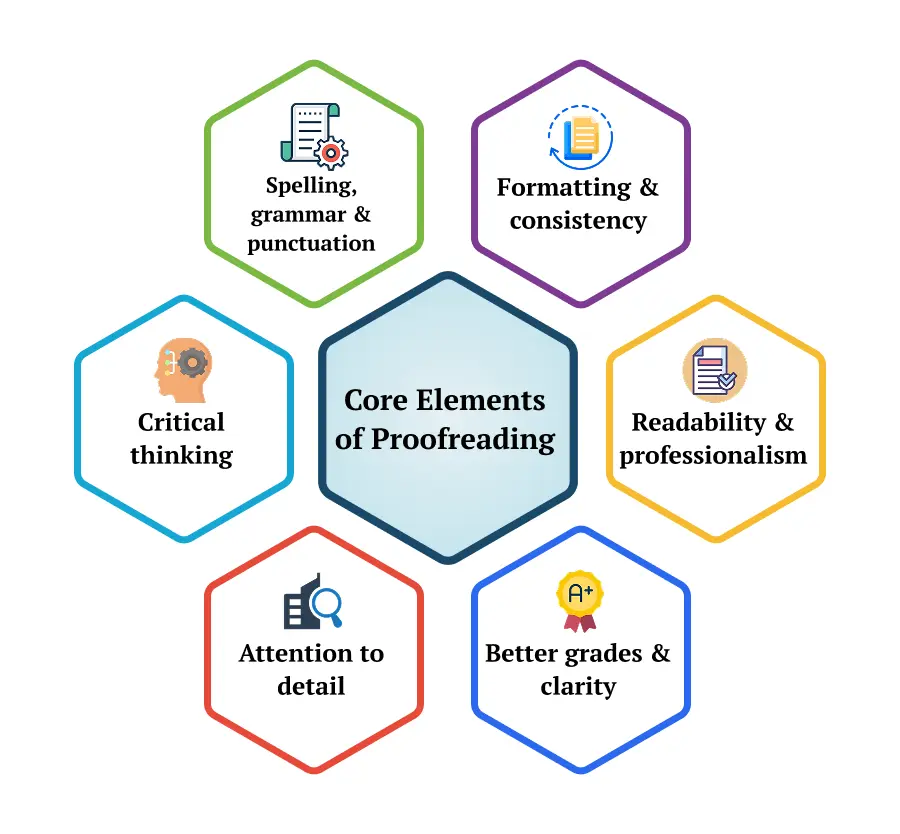
It is important to understand what is proofreading? It dwells upon the details of technical aspects that influence the level of readability and presentation of a document.
Key elements include:
-
Spelling accuracy across the entire document
-
Proper punctuation and sentence structure
-
Grammar consistency and tense alignment
-
Uniform formatting for headings, citations, and references
-
Consistent use of language style (UK or US English)
Academic work has a better professional appearance when it is carefully proofread. This brings about less ambiguity, improved readability, and increased grades for students.
Editing vs Proofreading – Key Differences
Editing comprises a holistic process of improving the content, content structure, clarity, and logical sense. The difference between editing and proofreading becomes clear in the final stage of editing, which is proofreading. At this stage, only minor mistakes and appearance-related issues are corrected, with no rewriting or rearranging of ideas.
Key distinctions include:
-
Editing enhances the meaning, clarity, and structure.
-
The process of proofreading eliminated language and formatting errors.
-
The sentences and paragraphs can be edited.
-
Evidence checking does not distort the information.
The awareness of these variations will facilitate the students to implement the right procedure at the right point of writing.
Types of Proofreading Approaches
The methodology also allows students to select a method based on their academic level and time limitations, as well as the significance of the submission. All strategies have different purposes and have their limitations.
Common proofreading approaches include:
-
Proofreading via a manual with numerous concentrated reviews.
-
Digital proofreading software, which performs simple grammar and spelling errors.
-
Academic proofreading of high stakes.
Manual proofreading helps establish a student to build a critical readiness in his or her writing habits; however, one can become more familiar with the text, thus resulting in missing the mistake. Digital tools are efficient and quick, but they tend to fail academically in tone, context, and other formatting. Accuracy, consistency, and adherence to academic standards have the highest level of precision in professional services.
Step-by-Step Strategy for Effective Proofreading
Knowing this about proofreading, along with a clear proofreading definition, will encourage students to view it not merely as a last-minute task but as a process that requires systematization. The better way to do this is by planning it out and dividing it into stages, and then proofreading.
The strategy of effective proofreading should consider:
-
Reviewing grammar, spelling, and punctuation as the first step
-
Checking consistency in headings, citations, and reference lists
-
Verifying formatting details such as spacing, numbering, and alignment
-
Taking short breaks to return to the document with fresh eyes
-
Completing multiple focused passes instead of one long review
This systematic method will minimize oversteps and provide a proper level of proofreading to avoid the unintentional emergence of additional errors.
Common Errors Students Miss
The difference between editing and proofreading becomes especially clear when reviewing the small but high-impact errors students often overlook during final checks. These mistakes do not affect ideas, but they do affect marks.
Some of the problems that are often neglected are:
-
Numerous typesetting mistakes and wrong homophones.
-
Use of comma splices and bad apostrophes.
-
Poor formatting, spacing, and alignment.
-
Lack of proper citation styles and reference list discrepancy.
-
Using the UK and US English in the same document.
Though they might not be very critical errors, thematic, they can be quite detrimental to academic assessment, and trivial to the quality of a submission in terms of professionalism.
Benefits of Professional Proofreading
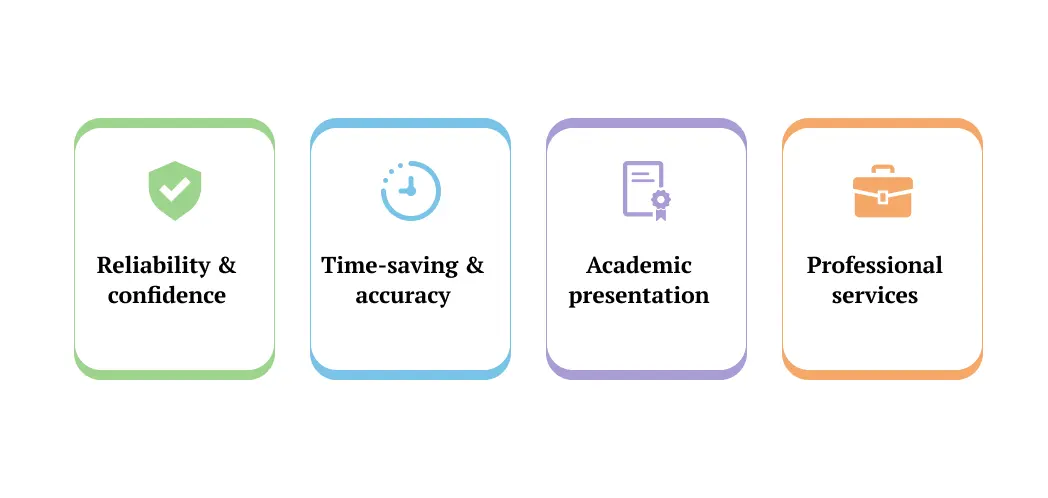
Professional-based proofreading is a practice that enhances reliability in academics, since it maintains accuracy, clarity, and consistency within a paper. Academic conventions are also used impartially, and institutional guidelines are taken into account to the letter by expert proofreaders.
Key benefits include:
-
Increased precision with lower rewards of penalties.
-
Enormous time can be saved during short deadlines.
-
Greater confidence in end-of-term academic work.
When writing high-stakes academic papers, students are advised to use reliable sources like Visit PhD Assistants in order to get expert advice on proofreading and quality maintenance.
Conclusion – Confidence Through Proofreading
Proofreading is an important factor for academic success as it ensures that all assignments are accurate, clear, and professional-sounding every time. Proofreading is useful for eliminating mistakes that students can easily avoid while submitting their assignments.
An understanding of the distinction between editing and proofreading will enable students to effectively utilize both. Editing will help improve content, organization, and flow, and proofreading is the last step to ensure the correction of minute errors and problems of presentation.
When students use systematic self-proofreading in combination with professional help if needed, they can present academic work that is confident, credible, and consistent, leading to improved performance.